Adaptive fill-in: how to mitigate the loss of an agent in decentralized federated learning

Carnegie Mellon University
Robotics Institute Summer Scholars 2024
Poster

Abstract

Distributed learning comes with many advantages pertaining to network efficiency and data privacy. However, it also suffers from a variety of well-known problems, including non-iid distribution of data or labels, varying network latency and reliability, unequal participation, and agent failures. In this paper, we focus on the extreme case of unequal participant, which is known as persistent failure. We present two baseline heuristics that do not try to adapt to the agent failure, and which show that taking no action leads to significant loss in performance. We also introduce a proof-of-concept adaptive patching strategy, which, via model-inversion attack, extracts data points resembling the original training data used by the lost agent. After the attack, it restores the lost agent and supplies them with the extracted data points for further optimization. Using this approach, we show that it is possible to restore a sizeable amount of performance after an agent is lost, opening a new avenue for further research in patching strategies for persistent agent failures.

Decentralized Learning

In decentralized learning, agents use their local data siloes to train their models, while regularizing to the neighbors they have access to. They all collaborate to reach a common goal of attaining the highest performance possible, while converging to the same model.

Adaptive Strategies for Overcoming Persistent Agent Failures in Distributed Learning

Agent failure scenario

Imagine that one of the agents participating in the distributed optimization has been permanently dropped from the system. In scenarios like this, whenever that agent had some unique knowledge about the data distribution, the performance of the system can drop significantly.

Adaptive Strategies for Overcoming Persistent Agent Failures in Distributed Learning

So what can we do about it?

An adaptive patching method

We propose a method that can restore the lost agent by attacking the latest model that we received from them. We want to perform a model-inversion attack to extract data points, which similar to those used by the lost agent during training. With these reconstructed data points, we can create a new agent and redeploy it to continue participating in the optimization process.

Optimization GIF

Results: performance

Test set accuracy after 300 rounds of peer-to-peer communication

Wine

Results 1

Iris

Results 1

Digits

Results 1

Results: convergence

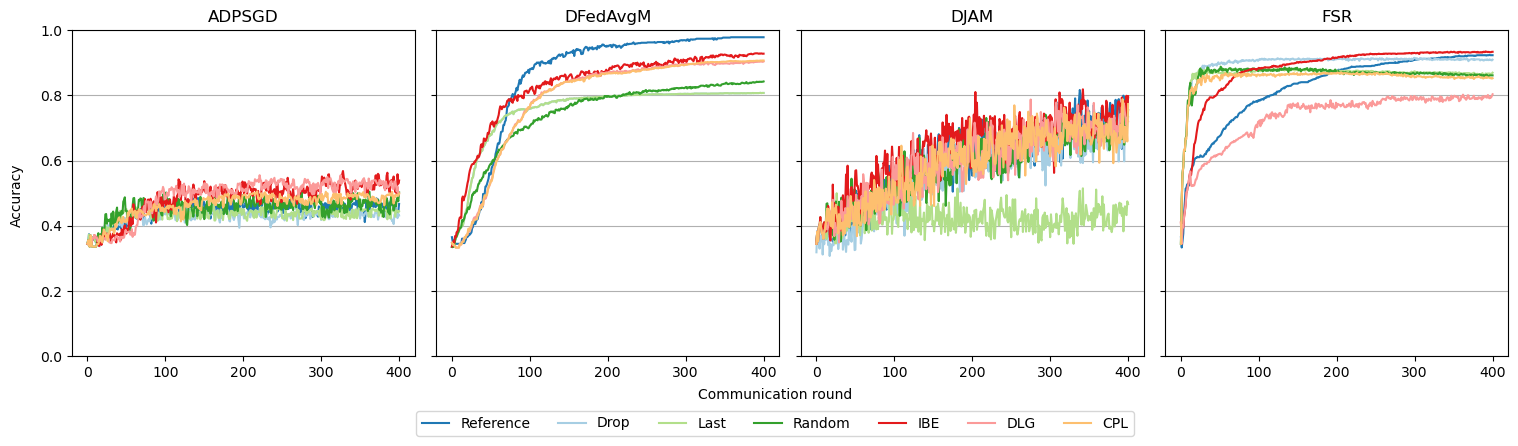
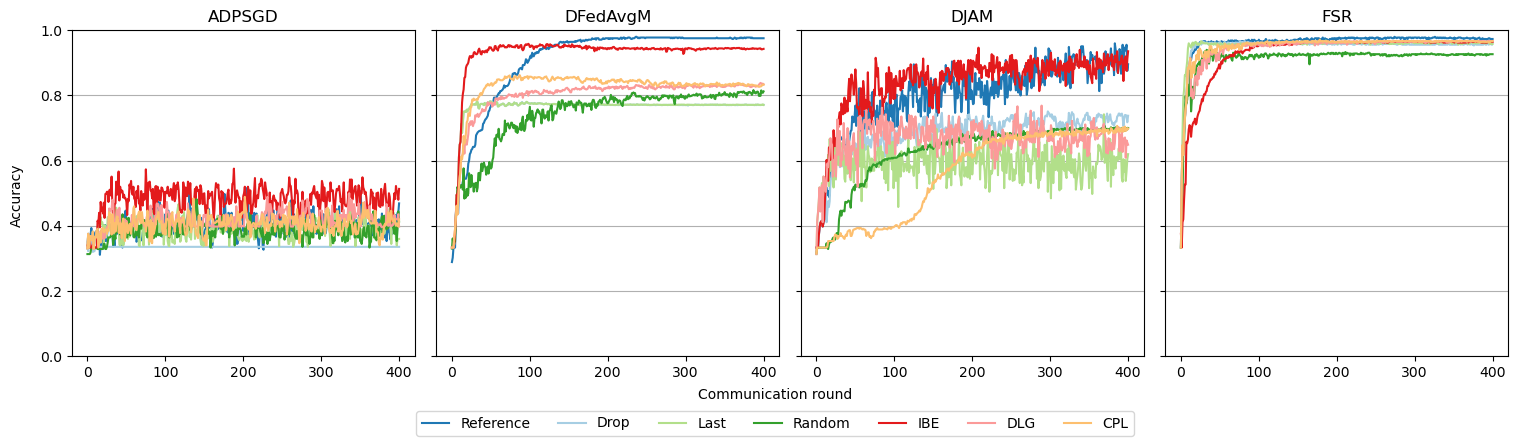
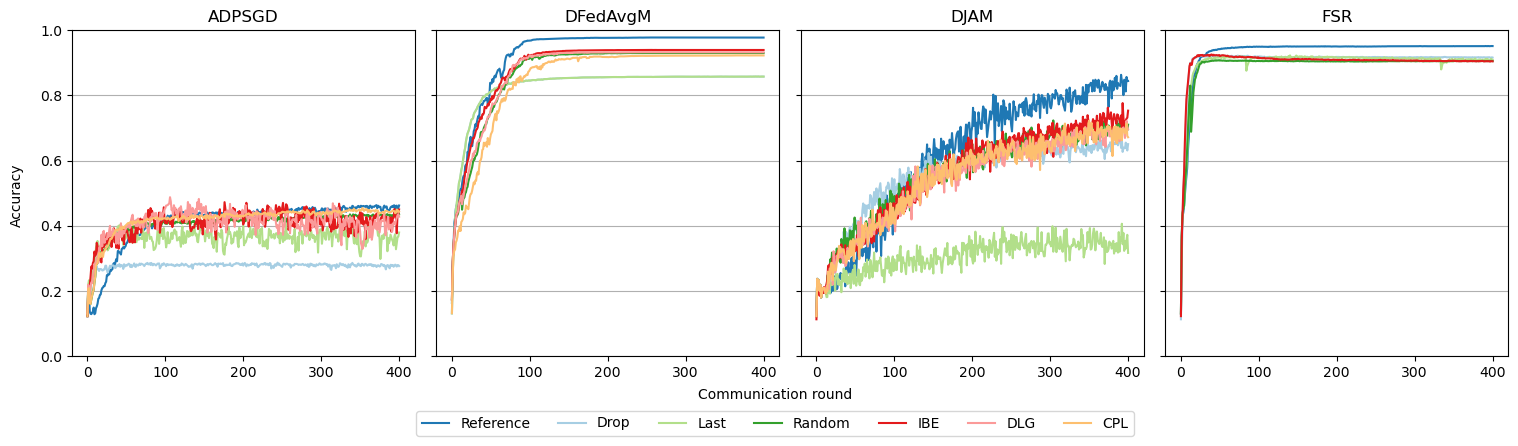
An analysis of the convergence of different decentralized learning algorithms and patching methods shows that the proposed model-inversion agent reconstruction method can restore the system's performance after a persistent agent failure and still lead to faster convergence than the baselines.

Wine

Results convergence

Iris

Results convergence

Digits

Results convergence
Disclaimer: paper preprint & code will be released towards the end of the year

BibTeX


        @article{Stepka2024strategies,
        author    = {Ignacy Stępka and Nicholas Gisolfi and Artur Dubrawski},
        title     = {Adaptive Strategies for Overcoming Persistent Agent Failures in Distributed Learning},
        journal   = {Robotics Institute Summer Scholars 2024},
        year      = {2024},
        note      = {Carnegie Mellon University},
        }